Weekly Article · Week 6
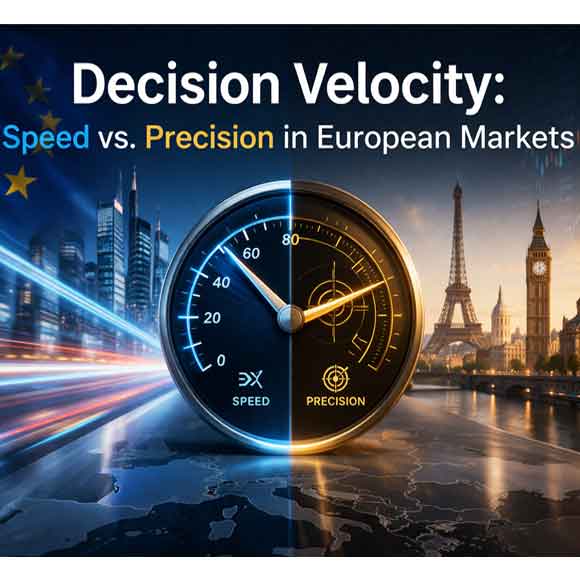
How German and European leaders make faster decisions without sacrificing the quality their markets demand
The European Decision Paradox
In a Stuttgart factory, a production manager waits three weeks for approval to switch component suppliers. The savings are clear. The risk is minimal. But the signature hierarchy stretches across four departments, each adding questions that delay rather than improve the outcome.
At a Berlin startup, a founder makes hiring decisions in hours. Three months later, they are managing out a cultural misfit that cost them a key client and team morale.
Both scenarios plague European business. The first is paralysis by analysis, the German Gründlichkeit taken too far. The second is velocity without vector, speed mistaken for progress.
European leaders face a unique tension. Their markets expect reliability, precision, and long-term thinking. Their competitors, often less regulated and more risk-tolerant, move faster. The answer is not to abandon thoroughness. It is to distinguish between decisions that deserve it and decisions that simply need completion.
The Cost of Slow Decisions in European Business
Decision delay carries specific costs in EU markets:
Market position erosion. While European teams deliberate, global competitors capture customers who will not wait.
Talent attrition. High-performing employees, particularly in tech and innovation roles, leave organizations where their recommendations disappear into approval loops.
Opportunity cost multiplication. In volatile markets, the option you analyzed last quarter may no longer exist when you finally decide.
Decision fatigue. Leaders exhaust themselves on low-stakes choices, leaving insufficient cognitive resources for genuinely consequential ones.
The German and European instinct toward thoroughness is not wrong. It is misapplied. Not every decision warrants a committee. Not every risk requires mitigation. The skill is knowing which is which.
The Two-Question Filter: Reversible vs. Irreversible
Jeff Bezos popularized this framework, but it requires adaptation for European regulatory and cultural contexts. The core question: Is this decision reversible or irreversible?
Reversible decisions can be undone with limited consequences. A marketing campaign, a software feature, a pilot program in one region. These deserve speed. Decide quickly, implement fast, learn from results, adjust or abandon. The cost of deliberation exceeds the cost of correction.
Irreversible decisions have lasting consequences that are difficult or impossible to undo. Major capital investments, structural reorganizations, regulatory commitments, and strategic partnerships. These deserve thoroughness. Take time, gather perspectives, stress-test assumptions.
The European trap: treating reversible decisions as irreversible. The compliance mindset, the fear of Fehlerkultur (error culture), the institutional memory of past mistakes all push toward excessive caution.
Practical application: Before any decision meeting, label the decision type explicitly. “This is reversible. We decide today.” Or “This is irreversible. We need two more weeks for due diligence.” The label itself accelerates appropriate speed.
Pre-Mortems: Precision Without Paralysis
German engineering culture excels at post-mortems. When something fails, teams dissect root causes with impressive rigor. But this skill applied only after failure is wasteful.
Pre-mortems apply the same analytical discipline before the decision. Imagine it is one year from now. The decision failed. Why?
This technique serves European leaders particularly well because it honors their analytical strengths while accelerating timeline. It surfaces risks without requiring endless scenario planning. It builds confidence through preparation rather than delay.
How to run a pre-mortem in under 60 minutes:
- State the decision clearly. “We are launching this product in Q3.”
- Imagine failure. “It is one year later. The launch failed. The product was withdrawn.”
- Generate reasons silently. Each participant writes all possible causes of failure for 10 minutes. No discussion yet.
- Share and cluster. Group similar causes. Identify patterns.
- Prioritize mitigations. Which causes are most likely? Which would be most damaging? Address the top three with specific actions.
- Decide. With risks surfaced and mitigations planned, the decision becomes faster, not slower.
The pre-mortem satisfies the European need for thorough risk assessment without the delay of sequential departmental reviews. Everyone contributes simultaneously. The decision emerges from collective intelligence in hours, not weeks.
The 70% Information Rule
German and European leaders often wait for certainty. They want complete data, consensus from stakeholders, and clear precedent. This is impossible in dynamic markets.
The 70% rule states: decide when you have approximately 70% of the information you would ideally want. The final 30% is either unavailable, too costly to obtain, or will arrive too late to matter.
This requires tolerance for ambiguity that European business culture does not naturally cultivate. Leaders must explicitly model it.
Phrases that help:
- “We have enough to proceed. We will adjust as we learn.”
- “Waiting for perfect information means deciding after competitors have acted.”
- “The cost of delay now exceeds the risk of imperfect decision.”
- “We are building in checkpoints to correct course. This is not permanent commitment.”
The 70% rule works best for reversible decisions. For irreversible ones, the threshold rises. But even then, 90% is usually sufficient. The pursuit of 100% is where European organizations lose their edge.
Decision Rights: Who Decides What
Slow decisions often stem from unclear authority. European hierarchies, particularly in German corporations with their dual board structures and works council involvement, create genuine complexity about who can decide what.
Leaders accelerate decisions by clarifying decision rights explicitly. This requires uncomfortable conversations about power, but the alternative is endless circling.
A simple framework:
- Decide: One person owns the decision. They gather input, but they decide.
- Consult: Decision maker seeks input before deciding. Input is genuinely considered but not binding.
- Agree: Decision requires consensus. All parties must align. Use sparingly for high-stakes, irreversible choices.
- Inform: Decision is made elsewhere. This person is notified after the fact.
Most European organizations default to “agree” for too many decisions. Shifting to “consult” or “decide” for appropriate choices dramatically accelerates velocity.
Implementation tip: For recurring decision types, document the decision right explicitly. “Supplier switches under 50,000 euros: procurement decides, consulting operations.” This prevents repeated negotiation of authority.
Building Organizational Tolerance for “Good Enough”
European quality standards are genuine competitive advantages. But perfectionism applied universally destroys speed.
Leaders must explicitly define “good enough” for different decision categories. This feels uncomfortable in cultures where Qualität is central to identity. Reframe it: “good enough for this context” is not “low quality.” It is appropriate quality.
Practical distinctions:
- Customer-facing product: High quality, thoroughly tested, meets all regulatory standards.
- Internal process improvement: Functional, safe, improvable. Launch and iterate.
- Experimental initiative: Viable for learning. Success is insight, not perfection.
- Administrative decision: Correct, compliant, timely. No additional optimization needed.
The leader’s role is to name the category explicitly. “This is experimental. We need viable, not perfect.” This permission liberates teams to move faster without feeling they have compromised standards.
The Speed-Quality Audit: A Tool for European Leaders
Apply this quarterly to your organization:
- Map ten recent significant decisions. Include timeline from first discussion to final decision.
- Categorize each. Reversible or irreversible? What decision right applied?
- Identify delay patterns. Where did decisions stall? Waiting for information, consensus, or courage?
- Calculate cost of delay. Estimate market impact, opportunity cost, or talent frustration for the slowest decisions.
- Design interventions. Would pre-mortems help? Clearer decision rights? Explicit “good enough” standards?
- Pilot changes. Test faster approaches on upcoming reversible decisions.
This audit builds organizational self-awareness about decision culture. It moves speed from abstract value to measured practice.
When German Thoroughness Is the Advantage
Not all decisions should accelerate. European markets reward reliability. Customers trust German engineering, Swiss precision, Nordic transparency because these cultures do not rush what matters.
The skill is discernment. Leaders who master decision velocity do not abandon thoroughness. They apply it selectively, with full force where it matters, and release it where it does not.
The DAX corporation that decides a factory location in months rather than years, with full due diligence, beats the competitor who decides in weeks and regrets for decades. The Mittelstand company that builds customer trust through consistent delivery earns loyalty that fast-but-flaky rivals cannot match.
Decision velocity is not about being fastest. It is about being appropriately fast. European leaders who master this distinction turn cultural strengths into competitive weapons rather than constraints.
The 30-Day Decision Velocity Challenge
Week 1: Audit your calendar. Identify three pending decisions that have stalled. Classify each as reversible or irreversible.
Week 2: For reversible stalled decisions, apply the 70% rule. Schedule decision meetings with explicit “decide today” mandates.
Week 3: Introduce pre-mortems for one upcoming significant decision. Train your team in the technique.
Week 4: Clarify decision rights. Document who decides what for your team’s most common decision types. Eliminate one “agree” where “consult” would suffice.
Final Thought
European business culture does not need to become Silicon Valley. It needs to become itself, but faster where appropriate. The precision that built German engineering excellence, the thoroughness that created trusted European brands, the long-term thinking that sustains family businesses across generations, these are assets.
But assets misapplied become liabilities. Thoroughness applied to reversible decisions is a waste. Speed applied to irreversible decisions is recklessness.
The European leader who masters decision velocity does not choose between German quality and American speed. They choose both, at the right moments, with clear intention.
Your next decision is waiting. Is it reversible?
Ready to accelerate your leadership impact? Halane Consultancy and Training Center in Hamburg offers executive coaching and corporate training programs designed for the European business culture.